

Autonomous vehicles (AVs) aim to enhance transportation safety, efficiency, and reliability. To achieve these goals, SOTIF (Safety of the Intended Functionality) provides a comprehensive framework to address inherent performance limitations and refine complex decision-making, complementing traditional Functional Safety (FuSa) standards.
SOTIF vs Functional Safety
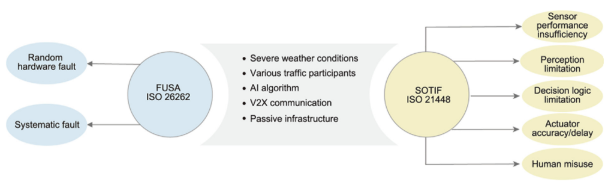
SOTIF (ISO 21448), also referenced in UL 4600 and ISO 34502, addresses safety risks arising from intended performance limitations and predictable misuse, rather than system failures.
Functional Safety (FuSa, ISO 26262) manages risks related to random and systematic faults.
Together, they form a comprehensive safety strategy, ensuring both technical reliability and operational robustness in complex environments.
Integrating SOTIF into AV System Design
While AI-based perception, decision-making and control modules enhance situational awareness and responsiveness, they introduce challenges regarding robustness, interpretability, and edge-case performance.
By applying SOTIF (ISO 21448) principles, engineers can ensure system safety even under uncommon environmental and traffic conditions.
This structured methodology enables rigorous testing and validation across MiL, SiL and HiL, facilitating the continuous improvement and verification of autonomous functions.
Standards and Best Practices for SOTIF
Leading OEMs and Tier 1 suppliers are actively integrating SOTIF throughout the vehicle development lifecycle:
- BMW: Implements multi-modal sensor and decision-making redundancies to mitigate inherent system limitations
- Bosch: Employs a rigorous V-model development process specifically tailored for SOTIF, emphasizing structured verification and validation (V&V)
- PEGASUS Project: Established a standardized 21-step methodology for the systematic assessment and validation of highly automated driving systems
Future Perspectives for SOTIF Autonomous Vehicles Safety
SOTIF represents a pivotal advancement in autonomous vehicle safety, bridging the gap between theoretical models and real-world operational robustness.
By fostering collaboration between academia, industry and regulators across the AV lifecycle, it serves as the foundational framework for safe and scalable mobility.
Ultimately, the rigorous application of SOTIF principles is the key enabler to build public trust and transform autonomous driving into a dependable everyday reality.
Written by Mario Noioso


