
The Evolution of Satellite Broadcast
For decades, satellite broadcast has represented quality, reliability, and scalability. Today, with media consumption increasingly fragmented across devices, pure IP models struggle to deliver consistent quality, sustainability, and predictable costs at scale.
Limitations of Traditional Broadcast
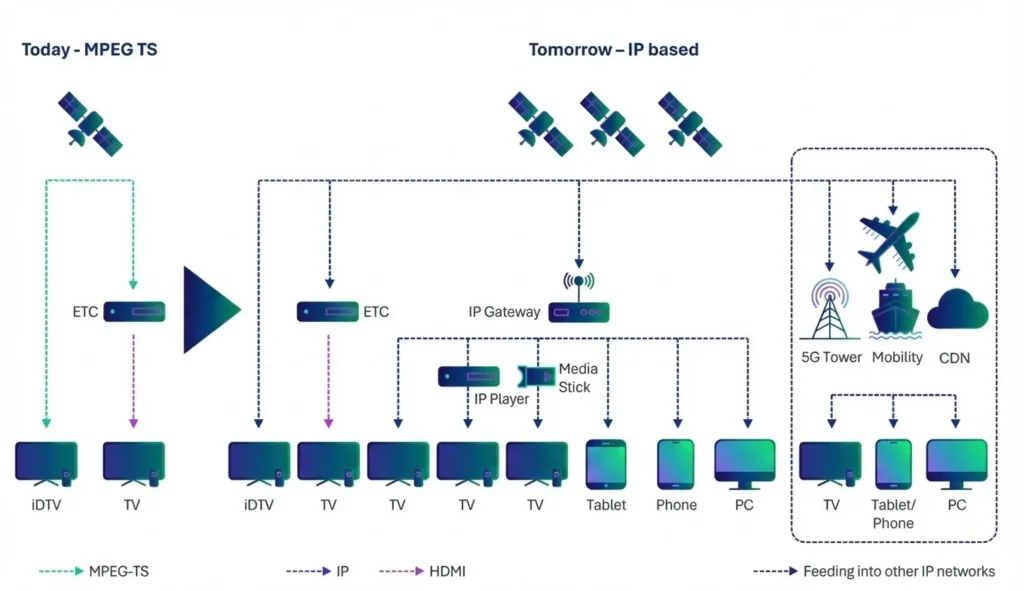
The MPEG‑2 Transport Stream (TS) is optimized for linear TV and one-to-many distribution, but it faces challenges in modern IP ecosystems:
-
Limited native compatibility with mobile devices
-
Need for transcoding into OTT formats (HLS/DASH)
-
Traditional set-top boxes cannot dynamically adjust bitrate or resolution
While OTT unicast offers flexibility, it introduces rising costs, CDN dependency, and challenges in delivering consistent quality during high-demand live events.
DVB-NIP: What It Is and How It Works
DVB-NIP (Native IP Broadcasting) transports native OTT content over DVB broadcast networks using GSE or backward-compatible MPE, via satellite or terrestrial networks. End devices receive unicast IP streams, offering a seamless experience on smartphones, tablets, and smart TVs regardless of the source.

Standards and Architecture
DVB-NIP is an open standard based on ETSI TS 103 876 and incorporates:
-
DVB-I: service discovery and metadata management
-
DVB-DASH/HLS: adaptive bitrate packaging
-
DVB-mABR: multicast ABR with unicast conversion
-
DVB-GSE: native IP encapsulation
-
DVB-S2X / DVB-T2: satellite and terrestrial transmission
Benefits of the Hybrid Model
Satellite ensures high quality and predictable costs, while IP adds flexibility, personalization, analytics, and targeted advertising. DVB-NIP enables new scenarios: live content in low-connectivity areas, distance education, mobility access, and mobile network offloading.
Efficiency and Sustainability
IP multicast reduces parallel unicast streams, lowering operational costs, energy consumption, and overall carbon footprint.
DVB-NIP: The Standard for the Future
DVB-NIP represents the natural evolution of satellite broadcast in the IP era, combining one-to-many scalability with OTT flexibility and personalization, simplifying distribution architectures and enabling new service models.
Written by Salvatore Martino


